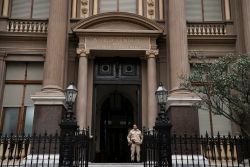
The Central Bank intensified its dollar purchases, adding more than USD 700 million in one week
The Central Bank intensified its dollar purchases, adding more than USD 700 million in one week
With the $80 million it acquired on Friday, it has now purchased foreign currency for 74 consecutive days. Slight increase in reserves
The Central Bank of Argentina (BCRA) has maintained a streak of 74 consecutive days of dollar purchases in the official market, through direct operations and block agreements with companies and organizations. This Friday, the entity added USD 80 million, and so far in 2016, the accumulated total has exceeded USD 6.7 billion .
With the implementation of the new monetary system in January of this year, the Central Bank of Argentina (BCRA) added USD 6.765 billion, far exceeding half of its annual target . During April, the pace of foreign currency acquisitions accelerated: purchases reached USD 2.379 billion that month. This week alone, the Central Bank acquired USD 745 million .
Currently, the monetary authority has covered 67% of its 2026 purchase target. However, debt payments made by the Treasury, partly with dollars channeled through the Central Bank, limited the net increase in reserves.
To sustain this pace, the central bank increased the issuance of pesos without using sterilization instruments, while the national treasury issued local currency debt to absorb excess liquidity and prevent further expansion of the monetary base. The aim is to contain potential pressures on the exchange rate and inflation.
According to official estimates, the net balance of purchases could range between US$10 billion and US$17 billion throughout 2026, depending on both the availability of foreign currency and the demand for pesos. The president of the Central Bank of Argentina (BCRA), Santiago Bausili , indicated that these variables will be key to the annual result.
At the close of trading on the last day, international reserves totaled USD 46.184 billion , a daily increase of USD 17 million. In February, the stock reached USD 46.905 billion, the highest level since 2018 and the highest under the current administration. The decline observed in recent months is due to both foreign currency debt payments and changes in the valuation of assets, such as gold and bonds, in a volatile international environment.
The dynamics of corporate debt will be key to the flow of foreign currency in the coming months, beyond the inflow of dollars from the agricultural export sector. Since the legislative elections of October 2025, Argentine companies have issued approximately $10 billion in debt in international markets .
A significant portion of those funds has already entered the local market, bolstering exchange rate stability. According to official estimates, over $3 billion remains to be liquidated, and its gradual incorporation could help maintain exchange rate stability.
In a meeting with investors in Washington, Central Bank Vice President Vladimir Werning explained that between October 2025 and April 2026, companies issued $9.9 billion in bonds, of which $6.8 billion has already entered the local market. An additional $3.2 billion remains to be issued , a sum that could increase the supply of dollars in the short term.
The dollar is approaching $1,400
The dollar showed an upward trend in the wholesale market, driven by increased hedging demand detected by traders, despite a high trading volume of $954.5 million . This occurred against a backdrop of significant foreign currency outflows from the agricultural export sector and a substantial inflow of dollars from corporate and provincial debt issuances.
Gustavo Quintana , from PR Corredores de Cambio, noted that this Friday saw a “record volume in the spot segment for 2026, surpassing the peak reached on December 29 of last year.”
The wholesale dollar price rose 7.50 pesos, reaching $1,399.50, its highest level since March 13. So far in 2016, the official exchange rate has fallen by 55.50 pesos, equivalent to 3.8 percent. During the last week, the commercial dollar gained 35 pesos, representing a 2.6 percent increase. The Central Bank set the upper limit of the exchange rate band at $1,693.51, so the wholesale dollar remains 294.01 pesos, or 21%, below that limit.