The Book Fair paid tribute to Mario Vargas Llosa with readings and an immersive exhibition
The Book Fair paid tribute to Mario Vargas Llosa with readings and an immersive exhibition
One year after the death of the Nobel Prize winner for Literature, the fair was the setting for an emotional gathering in which his literary and human legacy was remembered.
The figure of Nobel Prize winner Mario Vargas Llosa hovered over the halls of the Buenos Aires International Book Fair , when different voices recalled his literary and human legacy, and, at the same time, the immersive exhibition The Journey of Vargas Llosa: How the World Becomes Literature was presented in the White Pavilion of La Rural.
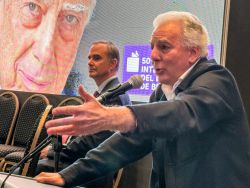
Among them was his son, Álvaro Vargas Llosa , who keeps his legacy alive, who in a year marked by the anniversary of the death of the author of Conversation in the Cathedral and The City and the Dogs , presented to the public a profound reflection on the transformation of the writer into a public symbol, the way in which his life and work blur on the border between the private and the collective, and the mark of fiction on those who read him.
The event, organized by the Vargas Llosa Chair and the Development Bank of Latin America and the Caribbean, began at 7:00 p.m. and took place in the Victoria Ocampo Hall. Also present were Morgana Vargas Llosa , the writer's daughter; the Peruvian Ambassador to Argentina, Carlos Alberto Chocano Burga; and the Mexican Ambassador, Lilia Eugenia Rossbach Suárez , among other figures from the cultural sphere.
The writer and journalist evoked the feeling of community: “We feel accompanied, somewhat less alone, somewhat smaller, thanks to all of you,” said Alvaro Vargas Llosa, recalling that the occasion coincided with the first anniversary of the author's death.
Álvaro framed the event around a fundamental tension: the disappearance of the “private man” to become collective property, evoking a poem by W.H. Auden dedicated to the death of Yeats . “The private man has disappeared and become public property. The private man has dissolved, he has been diluted into the public,” he quoted.
From that image, he drew a personal interpretation of how, after death, the public figure simultaneously takes root in the private memory of each reader: “That character that we, the loved ones, have lost and that has left the private sphere to become public property, once again comes to organize a private space as it takes root in the imagination of each of you,” he stated during the tribute.
The writer's son noted that, a year after his father's death, the exhibition creates a space where the author's life and literature manifest themselves in the dual dimension of the intimate and the public. He maintained that, by becoming a fictional character for the reader, Mario Vargas Llosa is simultaneously a shared memory and material for new personal inventions.
In his remarks, Vargas Llosa argued that the Peruvian writer dedicated his entire life to inventing other worlds and that this vocation, after his death, transformed him into “a fictional character”: “He has become an idea. Every time someone reads him, every time someone associates him with something that awakens in their imagination, my father has become that,” he explained. He emphasized that this “idea” is a product of each reader's individual interpretation: “Therefore, he has become a fictional character… It is fascinating to see how a person who dedicated his entire life to inventing other worlds… transforms himself into a fictional character,” he expressed.
Alvaro quoted one of Mario Vargas Llosa's central convictions about the link between author and character: “An author is always scattered among his characters, even those he finds most repugnant… There is a little of me in each of my characters,” he recalled. From there, he explained how fiction offered the possibility of living “many more lives than he was given to live,” transforming a single existence into a multiple and “polyhedral” experience.
Regarding utopia and the function of literature, he specified an ethical-artistic principle that Mario Vargas Llosa shared: “He said: 'We must seek utopia, we must not renounce utopia, even though utopia is by definition impossible. But we must avoid seeking it in the city, that is, in public life, in political life. We must channel those forces toward the world of culture, of art, of literature.'” He then emphasized that the Peruvian writer saw in literature the legitimate means to take ideals and fantasies to their extreme, in a realm where they do not generate social harm but rather expand human experience.
Alvaro highlighted his father's constant inquiry into "how, when, and why stories are born." He cited as an example Mario Vargas Llosa's first adult play, premiered in the early 1980s, in which the fundamental questions pursued throughout his career are laid bare: "Why does an event that might be commonplace, of little importance, acquire the significance of a fiction, of a story?" For the author, that question never had a definitive answer, although it fueled most of his literary explorations.